The Anglican Centre in Rome is the permanent Anglican Communion presence in Rome. It is the living reality of our Communion's commitment to the full visible unity of the Church, working collaboratively with all Christians for justice and peace in the world. It is also the base of the Archbishop of Canterbury's Representative to the Holy See, who is also the Director of the Anglican Centre in Rome. He liaises between Pope Leo and the Archbishop of Canterbury and works with Anglican Communion and Vatican bodies on joint projects for education, ecumenism, and shared mission.
The Centre works closely with the Catholic lay community Sant'Egidio in Rome, who minister to the poor and disadvantaged. In its work, the Centre seeks to bring down barriers of misunderstanding between Anglicans and Catholics: hosting scholars, art exhibitions and specialised courses, and creating a space for hospitality and encounter. We also encourage choirs from around the Anglican Communion to come to Rome to celebrate the Anglican choral tradition in the Eternal City.
Sixty years and more of service and witness
The first meeting between an Archbishop of Canterbury and a Pope since the Reformation took place in December 1960 in an informal encounter between Archbishop Geoffrey Fisher and Pope John XXIII at the Vatican.
The Anglican Centre in Rome was founded in 1966 following the historic meeting between Pope Paul VI and Archbishop Michael Ramsey in March of that year. Famously, as they parted, the Pope took off his Episcopal ring and placed it on the ring finger of the Archbishop. This gesture symbolised the friendship between the two Christian leaders and the hope that they cherished that this same love would also come to transform the relationship between their Churches. The Anglican Centre was to play a fundamental part in this transformation.
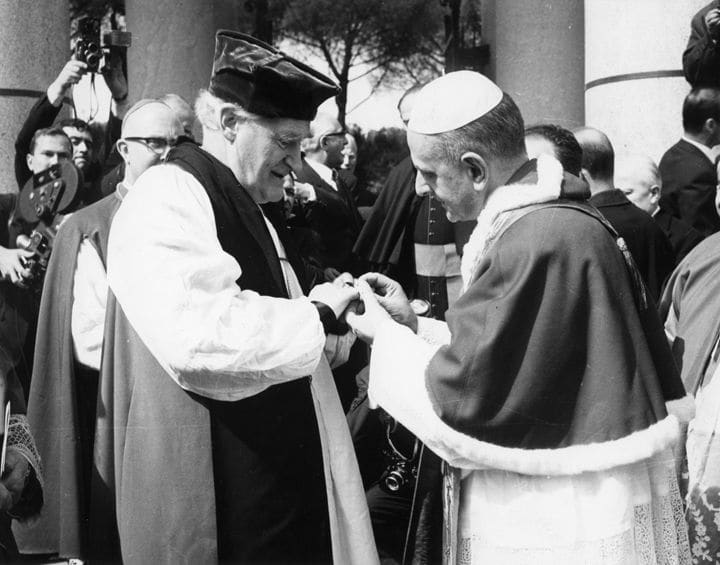
Pope Paul VI and Archbishop Michael Ramsey
The Centre was charged with developing a new relationship of friendship and deeper understanding between the Anglican Communion and the Roman Catholic Church, focussing on several areas which have continued to develop and flourish to this day.
For example, the Centre was integral to the establishment of a multi-faith anti-slavery network, working to combat human trafficking, engaging with Churches and agencies in Italy. In recognition of this, in 2015, the Centre received a Lampedusa Cross, made from a boat which sank off the island of Lampedusa in the Mediterranean.
What difference has the Anglican Centre made?
If we measure the growth in mutual awareness, understanding, trust and co-operation between the Anglican Communion and the Roman Catholic Church in decades, we can see five great steps forward:
- 1. Since Vatican II and its Decree on Ecumenism, we have totally embraced each other' Baptism: we are members one of another in the Body of Christ, in the life and community of the triune God.
- 2. It is now possible for Anglican and Roman Catholic priests to co-preside at the marriage of Anglican and Roman Catholic spouses.
- 3. We have witnessed agreement on the meaning of the great thanksgiving in the Eucharist as well as Baptism, and also in relation to 'the Church as Communion' and on the meaning of Christian marriage.
- 4. In principle, we concur on the crucial doctrine of justification by faith in Christ, unto good works.
- 5. We are working hard on doctrines about authority, Mary, the way in which the global and local Church holds together, and how to discerns right ethical teaching.
The Anglican Centre in Rome has been an embodiment of this progress and this journey in hope for almost 60 years. The Centre has sought to demonstrate that the Archbishop of Canterbury and the Anglican Communion are totally serious and fully committed to the belief that Jesus held up before us in John's Gospel "that they may all be one".
May they all be one; Even as you, Father, are in me, and I in you; may they be one in us, so that the world may believe that you have sent me.
— John 17:21
The Anglican Centre has sought to live this hope by being a presence, by encouraging conversation, by worship, hospitality and education, by the exchange of gifts and by initiating and encouraging, therefore communicating fresh ideas and best practice.