Our story forms part of the rich history of improving Anglican-Roman Catholic relations over the last century which commenced, in terms of dialogue, with the Malines Conversations in Belgium between 1921 and 1927.
These discussions were led by Lord Halifax and French priest Fr Fernand Portal, following the Lambeth Conference Appeal on the Reunion of Christendom in 1920, and were hosted by Cardinal Désiré-Joseph Mercier, Archbishop of Mechelen-Malines.
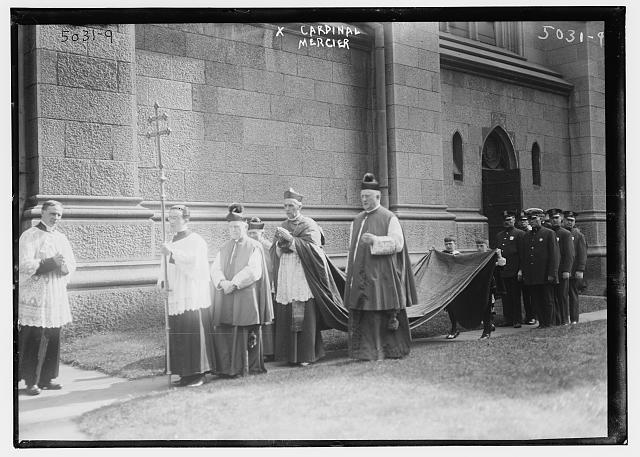
Cardinal Mercier in the USA in 1919 for a fundraising trip to rebuild the Library of Leuven, Belgium. Credit: Library of Congress Prints and Photographs Division LC-B2- 5031-9 [P&P].
This page seeks to be an introduction to the main initiatives and resources provided through the dialogues in recent decades. To see how this translates into recent stories of friendship around our world, please visit our interactive map.
When did an Anglican Archbishop of Canterbury first meet the Pope?
Archbishop Geoffrey Fisher and Pope John XXIII held a private meeting in the Vatican City in December 1960. All subsequent Archbishops of Canterbury have met the reigning Pope, often alongside representatives of other Christian traditions, in Rome and in other locations.
Video: Archbishop Fisher at the Vatican
These have included Canterbury during the pastoral visit of Pope John Paul II in 1982, Westminster in Pope Benedict XVI’s State Visit to the United Kingdom in 2010, and Juba, South Sudan, when Pope Francis, Archbishop Justin Welby and the then Moderator of the Church of Scotland, the Rt Revd Dr Iain Greenshields, visited in 2023.
Video: Ecumenical Pilgrimage of Peace
The current Archbishop of Canterbury, Archbishop Sarah Mullally, met with Pope Leo XIV on her pilgrimage to Rome in April 2026.
What was the Common Declaration?
Archbishop Michael Ramsey and Pope Paul VI issued their Common Declaration at the Basilica of St Paul’s Outside the Walls in March 1966.
The Common Declaration, in its own words, marked “a new stage in the development of fraternal relations, based upon Christian charity, and of sincere efforts to remove the causes of conflict and to re-establish unity” and affirmed their desire “that all those Christians who belong to these two Communions may be animated by these same sentiments of respect, esteem and fraternal love”.
Video: Canterbury to Rome
A full list of joint declarations from Archbishops of Canterbury and Popes and related documents is provided online by the Vatican’s Dicastery for Promoting Christian Unity.
The intention to begin a formal dialogue between the Roman Catholic Church and the Anglican Communion was announced in the Declaration. It also led to the formation of the Anglican Centre in Rome later that year.
What is ARCIC?
ARCIC is the Anglican Roman Catholic International Commission, which was founded in 1970, and builds on the initial work of the Anglican/Roman Catholic Joint Preparatory Commission. ARCIC has operated in three phases:
- ARCIC I from 1970 to 1981 covering Eucharistic doctrine, ministry and ordination, and authority in the Church.
- ARCIC II from 1983 to 2005, which considered salvation, the Church as communion, life in Christ, the gift of authority, and the position of Mary in Anglican and Roman Catholic theology.
- ARCIC III from 2011 has adopted the approach of receptive ecumenism which focuses on mutual learning and renewal, inviting each Communion to examine its own structures and discern what it can receive, as a gift from the other, for its own enrichment and reform.
All published documents from ARCIC are shared in the Anglican Communion’s online resource library.
What is IARCCUM?
IARCCUM is the International Anglican-Roman Catholic Commission on Unity and Mission and was formed in 2001 with a focus on the practical and pastoral dimensions of our relationship.
Its task is to examine how the theological agreements of ARCIC can be received and translated into a shared life of common mission and witness in the world. IARCCUM encourages bishops, dioceses and parishes to grow together through practical cooperation and spiritual partnership.
The work of IARCCUM is told through its documents in the Anglican Communion resource library and its own website at www.iarccum.org
What does dialogue look like at a more local level?
Anglicans and Roman Catholics are neighbours in all 42 provinces of the Anglican Communion, each of which has one or more counterparts among the episcopal conferences of the Catholic Church.
Anglican and Roman Catholic bishops meet at national and regional levels and in IARCCUM which highlights the work of these groups in Australia, Belgium, Brazil, Canada, England and Wales, France, Ireland, Japan, New Zealand, Nigeria, Papua New Guinea, Scotland, the South Pacific, Southern Africa, Sri Lanka and the USA.
New Stories to Tell: Living Ecumenism Today is an e-book published in 2018 by the Anglican-Roman Catholic Dialogue in Canada, sharing stories of local and personal Anglican and Roman Catholic connections and partnerships which have been made possible by what the ecumenical movement has achieved.

New Stories to Tell: Living Ecumenism Today
View resource →
Another outcome from a national dialogue, in the United States, is A Call to Reconciliation: A Joint Document from the Anglican-Roman Catholic Dialogue which was released at the beginning of Lent 2026 to offer a timely theological and pastoral reflection on reconciliation as a central dimension of Christian faith and witness.
Voices of Hope is a collaboration involving the Anglican Church of Southern Africa within the framework of the Pilgrims of Hope Jubilee Year proclaimed by Pope Francis for 2025. Its contents were collected into a book published in 2026.

Voices of Hope
View resource →
The Anglican Centre in Rome’s Shared Stories playlist on YouTube gathers videos which tell the stories of how Anglicans and Catholics have worked together in Hong Kong, Ireland and South Sudan and through the pairs of bishops who make up IARCCUM.

Shared Stories on YouTube
View resource →
Bishops, clergy and lay people in both traditions from many countries are among our regular visitors.