A special tour of San Marco

One of the most beautiful parts of the pilgrimage in the steps of St Paul in Rome in May was our visit to Basilica di San Marco al Campidoglio, the world’s first parish church. Permission was kindly granted by permission of the parish priest Monsignor Renzo Giuliano, as the basilica is currently closed to the public due to extensive renovation work. A presentation was provided by Don Fernando Romero, a doctoral student at the Pontifical Gregorian University.
Many visitors to the Eternal City will have walked past its doors on the way to the Piazza de Venezia bus stops. Indeed, it forms part of the impressive palazzo of that name – once the Embassy of Venice.
Once renovations are complete, visitors will be able to walk down into its crypt and there review the remains of a Roman street, and look into the second oldest baptistery in the world. The first was in the Basilica of St John Lateran, consecrated in 324 AD, and San Marco’s foundation followed in 336 AD.
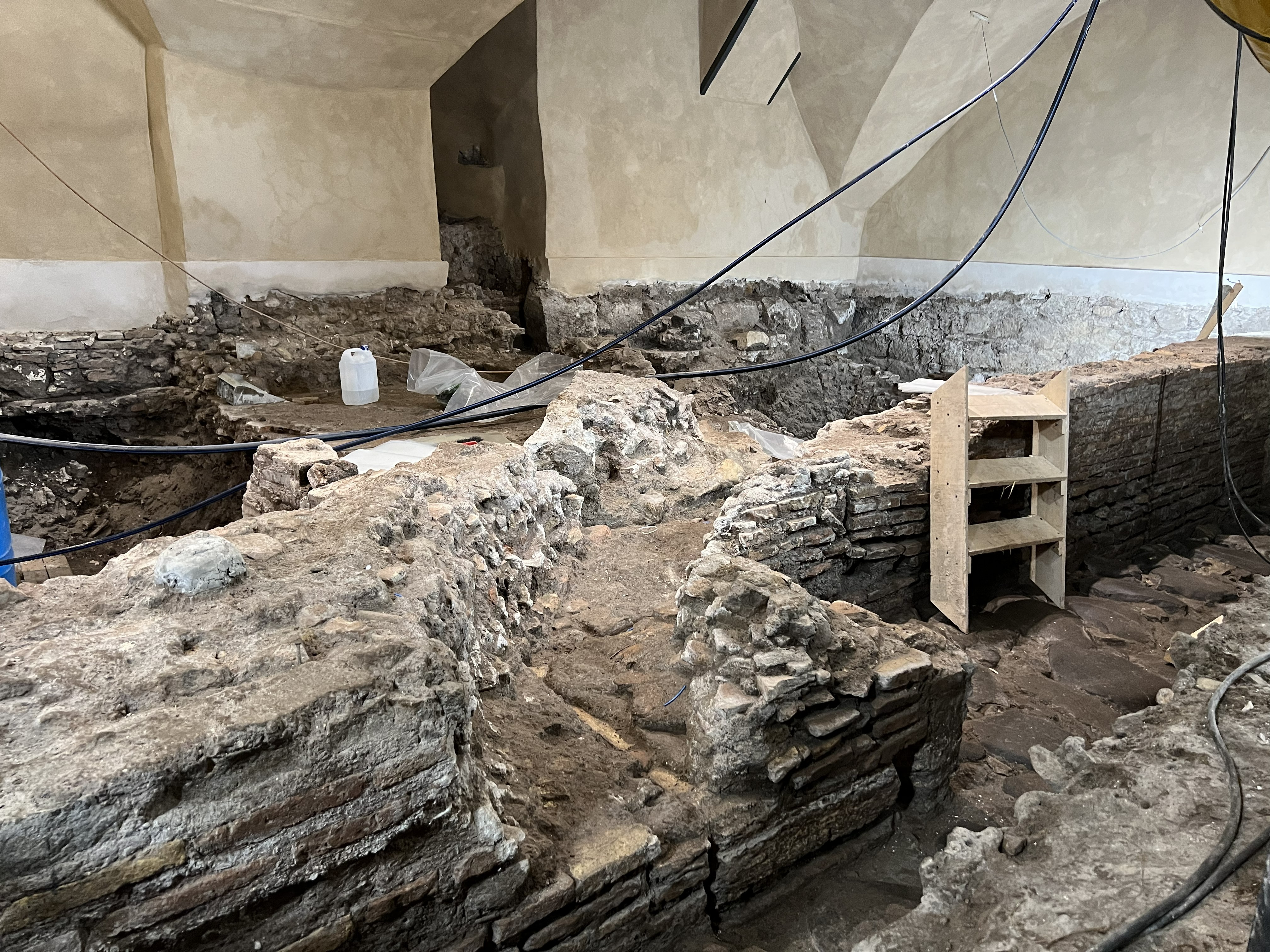
Unlike many churches of its time, San Marco was not constructed over the remains of a martyr but instead over a Roman house that later became a Christian place of worship. It preserves the memory of St Mark who, it is thought, lived here so that he could visit and provide for St Paul – in house arrest on the site of Chiesa di Santa Maria in Via Lata or the Church of San Paolo alla Regola – and St Peter, in the Mamertine Prison on Capitoline Hill, whose teaching forms Mark’s Gospel.
Tradition holds that St Mark was exiled from Rome to Alexandria in a similar way to the exile of Aquila and Priscilla from Rome to Corinth in 49 or 50 AD (see Acts 18.2-3). The latest date given for the martyrdom of St Mark is 72 AD, and some of his relics were later brought back to Rome, to rest there. The building was restored by Pope Gregory IV in the 9th Century and its magnificent apse mosaics date from then.
The basilica predates the Venice and became the church of the Venetian community in Rome around the time of the palazzo’s construction in the 1450s. Pope Paul III, whose coat of arms decorate the ceiling, gave official recognition to the Jesuits – the order of our guide Fr Scott Brodeur – in San Marco at this time. The interior was later reconstructed in a Baroque style.